How to figure out how much to offer for a property

When I was a kid, I remember my mother talking to a local real estate agent, Carol, about selling our family home.
Carol asked Mum how much she was hoping to sell for. Mum replied: "I've seen properties online listed for $250,000." (This was a long time ago.)
I'll never forget what Carol, the agent, said:
"Don't base your price on what's selling. Base it on what's sold."
Because an asking price is just a wish from the seller. Properties that have sold show you how much buyers are really willing to pay.
And if you can find out what properties have sold for, then you can:
a) know what your house might sell for.
b) know how much to realistically offer to buy a house.
But how do you get that data? Some agents pay hundreds a month to get it.
That's why one of my favourite features on realestate.co.nz is the Sold section.
It lets you see what buyers have actually paid for similar properties to the one you either own or are hoping to buy.
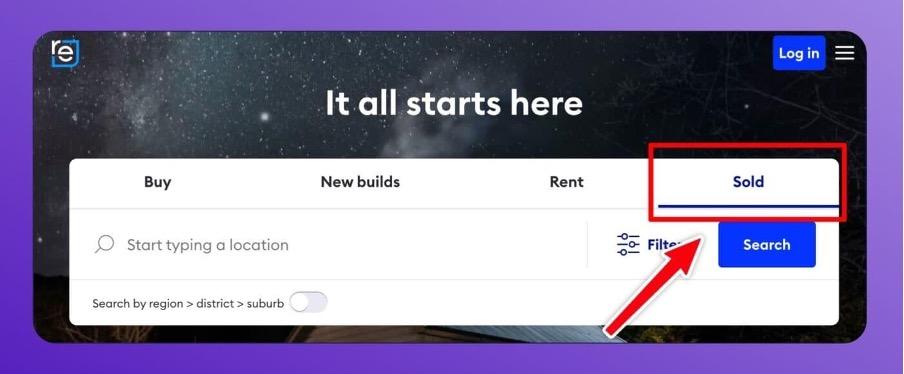
Search the suburb you're interested in, then use the filters to find homes that are as similar as possible to the property you're selling (or want to buy).
Start with the obvious things:
- Number of bedrooms
- Number of bathrooms
- Similar land size
- Similar floor area
- Similar age
Then don't just look at one sale.
Pull together five to ten properties and compare for yourself.
It doesn't need to be complicated. A simple spreadsheet with the address, number of bedrooms and bathrooms, land size, floor area and sale price is enough to start spotting patterns.
Once you've got your list, ask yourself one question for every property: Is this home better, worse or about the same as the one I’m interested in (or looking to sell)?
That's where the real value comes from.
A home with a renovated kitchen, better views or a larger section should probably sell for more than yours.
A smaller, older property with fewer bedrooms should probably sell for less.
And remember, while many property websites will give you an estimate for what the property could sell for, that's just based on an algorithm. The algorithm can't (yet) look at the pictures like you can. It can't see the renovated kitchen. It can't see the condition of the property.
But you can.
Case study: How much should you offer for this property?#
Let's say you're looking at this property as a buyer.
It's a 4-bedroom, 2-bathroom home with double garaging, a 286sqm floor area and sits on an 813sqm section. It was built in 2005. But it's currently up for auction, so you can't see what the seller is expecting.
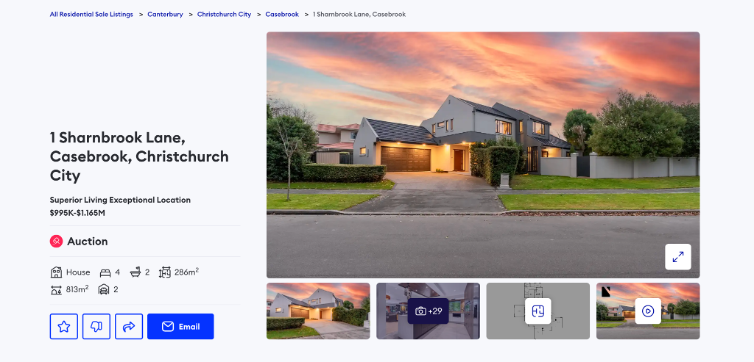
According to realestate.co.nz’s algorithm, the property's current price estimate is $995,000 to $1,165,000.
But is that actually what buyers are likely to pay?
To find out, I searched recently sold properties in Casebrook and compared them against Sharnbrook Lane.
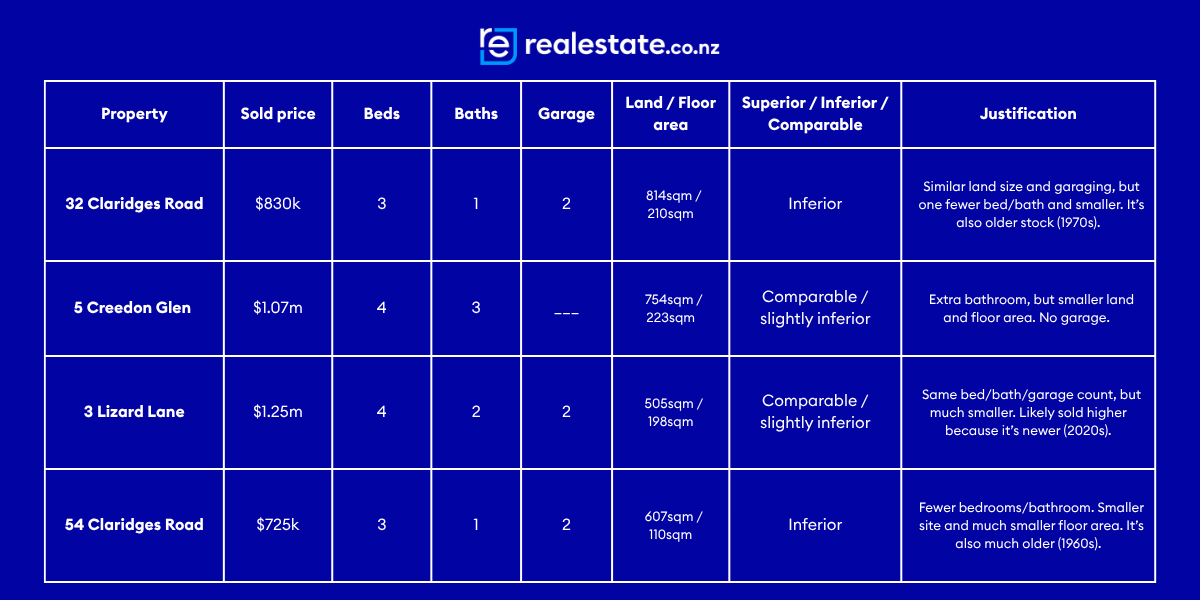
Based on these comparable sales, I'd expect the property to sit somewhere between about $1.08 million and $1.18 million.
That lines up reasonably well with realestate.co.nz’s price guide.
However, based on this analysis, you’d know that it’ll likely sell toward the upper half of that range.
Now, doing this won’t let you predict the exact sale price. No one can. But it can help you become an informed buyer and know what to expect when you turn up for auction.
That way, you'll know what value looks like in the current market.
Instead of negotiating based on emotion, you're negotiating based on comparable sales. That’s exactly what real estate agents also look at. So using this data helps you speak their language.
All these years later, I know that Carol was right. Base your property expectations not on what's selling. Base them on what's sold.
About the author#
Ed McKnight is the Resident Economist at Opes Partners, where he helps New Zealanders better understand property, the economy and how property investment can support their long-term financial goals.
With more than five years’ experience as an economist at Opes Partners, Ed keeps a close eye on economic trends, market data and the factors shaping property investment across New Zealand. He is also a member of the Institute of Directors.
Ed hosts the Property Academy Podcast and regularly shares his insights across New Zealand media, including NZ Property Investor, Informed Investor, Stuff and BusinessDesk. He has also appeared on television programmes including The Project and Breakfast.
Meet Ed McKnight, the economist at Opes Partners.
Ready to start searching? Discover the place that’s right for you#
Explore the latest listings across New Zealand on realestate.co.nz.
Want more property insights?#
- Market Insights: Search by suburb to see median sale prices, popular property types and trends over time.
- Switch your search to Sold to browse all residential properties that have sold - not just recent sales. See the most recent sale price and estimated current market value.