March Rental Report: New listings and stock ease
- 6,629 new rental properties were listed on realestate.co.nz in March, down 3.2% year-on-year the first drop for 2026.
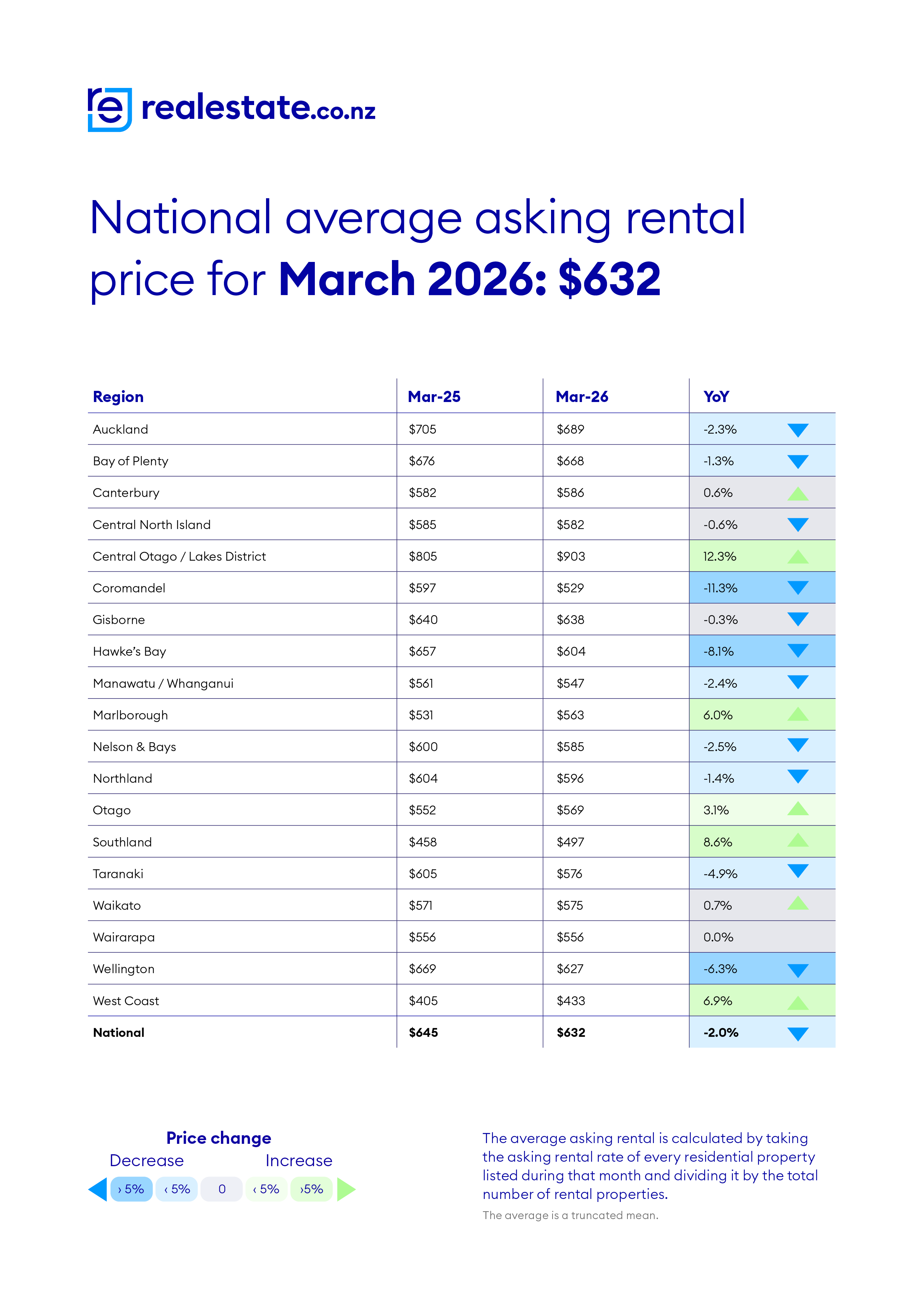
- National average rental price down 2.0% year-on-year to $632/week
- Central Otago Lakes District hits another all-time rental high, up almost $100 compared to March 2025 to $903/week
Latest data from realestate.co.nz shows new rental listings are down 3.2% compared to March 2025, with total stock also easing slightly, down 2.8% on the same time last year. In March, 6,629 new rental properties were listed on realestate.co.nz compared to the 6,850 last year. Meanwhile, rental stock was 7,473, compared to 7,688 in March 2025.
Vanessa Williams, spokesperson for realestate.co.nz says, while the decline is relatively modest, even subtle changes in supply can influence how much choice renters have.
While the drop in new listings isn’t overly dramatic, it does raise the question, where are all the rentals going? With fewer properties coming online and slightly less overall stock, those looking for a new rental may be noticing a shift in the level of choice available,” says Williams.
These changes aren’t being driven by a single factor, but rather a mix of influences, from investor sentiment to ongoing cost pressures and market cycles.
Decline in national average rental price provides respite for some but not all
Encouragingly for renters, the slight dip in new listings and stock hasn’t yet translated into rising prices at a national level. The national average rental price is $632/week, down 2.0% on March 2025 when it was $645/week.
But there’s always an exception to the rule. Central Otago Lakes District has delivered yet another all-time high with the region’s average rent sitting at $903/week, $1 more than last month and nearly $100 higher than the same time last year.
Williams says while it’s encouraging to see national rents ease slightly, renters in some regions will still be feeling the pressure of rising rents.
With fewer properties available, any sustained increase in demand could start to put upward pressure on prices again. The market is relatively stable for now, but in regions like Central Otago Lakes District, where demand continues to outstrip supply, renters continue to pay well over the national average.
Regional trends in supply highlight a varied rental landscape
Despite the decline in new rental listings nationally, some regions have seen uplifts.
Hawke’s Bay, Southland, and Gisborne all recorded notable year-on-year increases in rental listings, up 38.3%, 36.1%, and 28.9%, respectively. In contrast, Otago experienced a 37.4% decline in new rental listings, falling from 203 properties in March 2025 to 127 properties this year.
Williams says these regional differences reflect the diverse nature of New Zealand’s rental market.
While some regions are seeing a lift in new listings, others are tightening significantly, and that variability is shaping very different experiences for renters depending on where they are,” she says. “For tenants, it pays to be prepared and act quickly, while for property owners, these conditions highlight the ongoing demand for well-presented rentals.
For media enquiries, please contact:
Hannah Franklin | hannah@realestate.co.nz
Want more property insights?
- Market Insights: Search by suburb to see median sale prices, popular property types and trends over time.
- Sold properties: Switch your search to sold to see the latest sale prices and an estimated value in the current market.
-1.jpg?image_size=3840x2560&compress=true)
-1.jpg?image_size=3840x2487&compress=true)